
Best Bitumens for Cheap and Easy Roof Waterproofing

Given the increasing construction costs and the importance of proper roof waterproofing to prevent water penetration and save energy, finding cost-effective and easy-to-implement waterproofing methods is particularly important. In this regard, emulsified and cutback bitumens, due to their specific properties and the possibility of use without heating, are considered suitable options for low-cost and easy-to-implement roof waterproofing. By carefully examining these two types of bitumen and their applications, the best choice for this purpose can be made.
As mentioned in the article “Types of Bitumen and Their Various Applications,” bitumen is a vital material with water impermeability and strong adhesion properties, making it very suitable for waterproofing. Among the variety of bitumens, emulsified and cutback bitumens, due to their liquid nature at ambient temperature and the possibility of use without heating, are attractive for easy and cheap roof waterproofing.
Emulsified Bitumen: A Safe and Environmentally Friendly Option for Cold Waterproofing
Emulsified bitumen, as explained earlier, is produced by dispersing bitumen in water with the aid of an emulsifying agent. This process reduces the viscosity of the bitumen, allowing it to be used at lower temperatures and without the need for heating.
Types of Emulsified Bitumen Suitable for Roof Waterproofing:
- Slow-Setting (SS) Emulsified Bitumen: The high stability of this type of emulsion provides sufficient time for its uniform application on the roof surface. Anionic slow-setting (SS) emulsified bitumen is particularly suitable for surfaces with a positive charge.
- Medium-Setting (MS) Emulsified Bitumen: With a moderate breaking speed, this type of emulsion can be used for applications requiring mixing with fine aggregates or the application of relatively thicker layers.
Advantages of Emulsified Bitumen for Waterproofing:
- Relatively Low Cost: Compared to hot-applied bitumens, the purchase and application costs of emulsified bitumen are usually lower.
- Ease of Application: It is applied cold in liquid form and does not require complex heating equipment.
- High Safety: The absence of the need for heating eliminates the hazards associated with working with hot bitumen.
- Greater Environmental Compatibility: Its water-based nature creates less pollution compared to cutback bitumen.
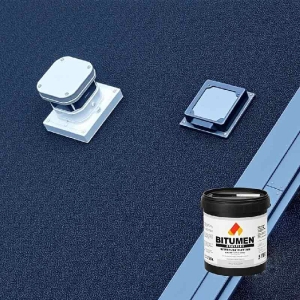
Cutback Bitumen: Ease of Application at Low Temperatures with Specific Considerations
Cutback bitumen is obtained by dissolving pure bitumen in a petroleum solvent. The evaporation of the solvent leaves the bitumen on the surface. The rate of solvent evaporation determines the type of cutback bitumen (rapid-curing, medium-curing, slow-curing).
Types of Cutback Bitumen Suitable for Roof Waterproofing (with Consideration):
- Slow-Curing (SC) Cutback Bitumen: Due to the slow evaporation of the solvent, it provides more working time and can be suitable for surfaces with low porosity.
- Medium-Curing (MC) Cutback Bitumen: Its moderate evaporation rate allows for the application of thin waterproofing layers.
Advantages of Cutback Bitumen for Waterproofing:
- Application at Low Temperatures: It does not require heating and can be used at lower temperatures.
- Ease of Application: It is liquid and can be applied with simple tools.
- Good Penetration (in some cases): The solvent present can help the bitumen penetrate some surfaces better.
Disadvantages and Considerations of Cutback Bitumen:
- Environmental Concerns: The evaporation of petroleum solvents leads to air pollution.
- Safety: Solvents are flammable and require adherence to safety precautions during use and storage.
- Odor: The strong odor of solvents can be unpleasant.
- Solvent Cost: The cost of solvents can affect the final price.
Comparison and Selection Between Emulsified and Cutback Bitumen for Waterproofing:
Both emulsified and cutback bitumens have their advantages and disadvantages for cheap and easy roof waterproofing without the need for heating.
- If the priority is safety, environmental compatibility, and ease of application with minimal considerations, emulsified bitumen (especially slow-setting and medium-setting types) is the preferred option.
- Cutback bitumen (especially slow-curing and medium-curing types with low viscosity) can be considered in specific situations where greater penetration into the underlying surface is required or in projects with severe budget constraints. However, attention to safety and environmental issues during its use is essential.
Important Points in Using Emulsified and Cutback Bitumens for Waterproofing:
- Surface Preparation: The surface must be completely clean, dry, and free of any contamination.
- Weather Conditions: Avoid application in rainy or very cold weather.
- Layering: For effective waterproofing, multiple layers may be required.
- Follow Manufacturer’s Instructions: Always follow the manufacturer’s instructions regarding application methods and consumption rates.
- Proper Ventilation (for cutback bitumen): Ensure proper ventilation when using cutback bitumen.
- Safety Precautions (for cutback bitumen): Avoid contact with skin and eyes, and use appropriate safety equipment.
Conclusion:
Both emulsified and cutback bitumens can be suitable options for cheap and easy roof waterproofing without the need for heating. Emulsified bitumen is the preferred choice for most projects due to its greater safety and better environmental compatibility. However, cutback bitumen can also be effective in specific situations, provided that safety and environmental considerations are carefully observed. The final choice depends on the project conditions, budget, and the client’s priorities.






I plan to waterproof my flat roof myself. The house is located in an area with hot summers and relatively mild winters. My main priorities are ease of application and reasonable cost, but safety and environmental concerns are also important to me. Based on the article, which option—emulsified bitumen or cutback bitumen—is more suitable for me, and why? Are there any specific practical tips for applying it myself?
Your question is very precise and practical, as it covers all the important aspects that a homeowner or small contractor considers when choosing a roof waterproofing method. Based on the comprehensive information in the article and your priorities (ease of application, reasonable cost, safety, and environmental considerations), emulsified bitumen will be a far more suitable option for you.
Why Emulsified Bitumen?
Ease of Application: Emulsified bitumen is applied in liquid, cold form and requires no heating or complex equipment. This feature makes it very easy and hassle-free for self-application.
Significantly Higher Safety: The most crucial advantage of emulsified bitumen for you is the complete elimination of hazards associated with working with hot bitumen and flammable solvents. This brings the risk of burns or fire to zero, which is vital for a DIY (Do-It-Yourself) application.
Greater Environmental Compatibility: Since it is water-based and does not contain volatile petroleum solvents, it has less odor and produces no air pollution or harmful fumes. This is more pleasant for you and your neighbors.
Reasonable Cost: Given the lack of need for heating equipment and less complexity in application, the overall cost of purchase and application is usually reasonable.
Practical Tips for Applying Emulsified Bitumen Yourself:
Surface Preparation: This step is critical. Ensure the roof surface is completely clean, dry, and free from any dust, leaves, branches, grease, or moisture. Repair any large cracks or holes beforehand.
Choosing the Emulsion Type: For roofs, slow-setting (SS) emulsions are typically used because they provide sufficient working time for uniform spreading and application.
Application Tools: You can use a paint roller (with long nap for better coverage), wide brushes, or even a rubber squeegee to spread the emulsion.
Apply Thin Layers: Instead of one thick layer, apply multiple thin layers (e.g., 2 to 3 layers) with specific drying intervals (usually a few hours, depending on air temperature and manufacturer’s instructions). This method ensures each layer dries properly and creates better adhesion between layers.
Weather Conditions: Always work in sunny weather with no rain. Avoid application in very cold weather (below 5 degrees Celsius / 41 degrees Fahrenheit), as drying will be prolonged.
Proper Drainage: Although emulsified bitumen waterproofs, your roof should still have proper drainage so that water does not accumulate on it and is directed towards the gutters.
Post-Application Test: After complete drying (usually a few days), you can test for leaks by pouring water onto a section of the roof.
By choosing emulsified bitumen and following these tips, you can easily and confidently waterproof your home’s roof.
For cheap and easy roof insulation without the need for heat, what advantages does emulsified bitumen have over cutback bitumen, and which type is preferred for this purpose?
Thank you for carefully reading the article. Here is the answer to your question:
For cheap and easy roof insulation without the need for heat, emulsified bitumen is often the preferred option due to its significant advantages over cutback bitumen.
Advantages of Emulsified Bitumen over Cutback Bitumen for Insulation:
High Safety: The primary advantage of emulsified bitumen is it doesn’t require heating. This completely eliminates the risks associated with working with hot bitumen, such as burns or fires. In contrast, cutback bitumen contains flammable petroleum solvents that necessitate strict safety precautions.
Greater Environmental Compatibility: Emulsified bitumen is water-based. This means that during the drying process, water evaporates, avoiding the air pollution caused by the evaporation of petroleum solvents (VOCs) found in cutback bitumen.
Easier Application with Fewer Considerations: Although both types can be applied at low temperatures, emulsified bitumen offers a simpler and less problematic application due to the absence of odorous and flammable solvents.
Preferred Type of Emulsified Bitumen for Roof Insulation:
Among the types of emulsified bitumen, Slow-Setting (SS) emulsified bitumen is generally preferred because its high emulsion stability provides ample time for uniform application on the roof surface. This characteristic allows for more relaxed and precise insulation work, preventing the creation of weak points in the insulation layer. Medium-Setting (MS) emulsified bitumen can also be used in cases where mixing with fine aggregates is required, but for general roof insulation, the slow-setting type is usually favored.
It’s actually a great and helpful piece of information. I am glad that you shared this helpful information with us. Please keep us informed like this. Thanks for sharing.
Wow! Thank you! I constantly wanted to write on my blog something like that. Can I take a fragment of your post to my website?
That’s wonderful to hear! I’m delighted that the post resonated with you so much that you want to share it on your own blog.
Yes, you absolutely can take a fragment for your website!
I’d be honored. All I ask is that you please provide a clear link back to the original post on my site as the source
The article mentions the environmental concerns with Cutback Bitumen due to VOC emissions. How long does the solvent smell and the VOCs actually linger after application on a roof, especially in a residential area?
The solvent smell from Cutback Bitumen can linger for several days to a week, depending on the grade (MC/SC) and weather conditions (ventilation, temperature). This is the key environmental concern, as Volatile Organic Compounds (VOCs) are continuously released until the solvent fully evaporates. Emulsified Bitumen is the safer choice for occupied or residential buildings due to its water base.
If cutback bitumen offers better subsurface penetration due to the solvent content, why are the environmental and safety concerns so high that emulsion is usually preferred? Can the evaporation of solvents (VOCs) affect the final insulation quality?
Cutback bitumen offers good penetration thanks to the petroleum solvent (like kerosene), but the core problem is the evaporation of Volatile Organic Compounds (VOCs). These solvents are flammable, create strong odors, and are air pollutants. These safety and environmental challenges, especially in populated areas, make its application highly problematic and usually tilt the scale in favor of emulsified bitumen. While solvent evaporation eventually leaves the pure bitumen, if the process is rushed or incomplete, residual solvent can indeed weaken the final insulation properties.
I don’t have any professional tools. Can I really apply emulsified bitumen with a regular paint roller on the roof?
Yes, that is exactly the main advantage of emulsified bitumen. You only need a long-nap roller or a wide brush. Since it’s cold-applied and has low viscosity, it spreads like thick paint. Just make sure if the roof is concrete, apply the first layer slightly thinner to ensure it penetrates the pores well.