
Top 10 Kerosene Producing Countries 2026: The Aviation and Industrial Powerhouses
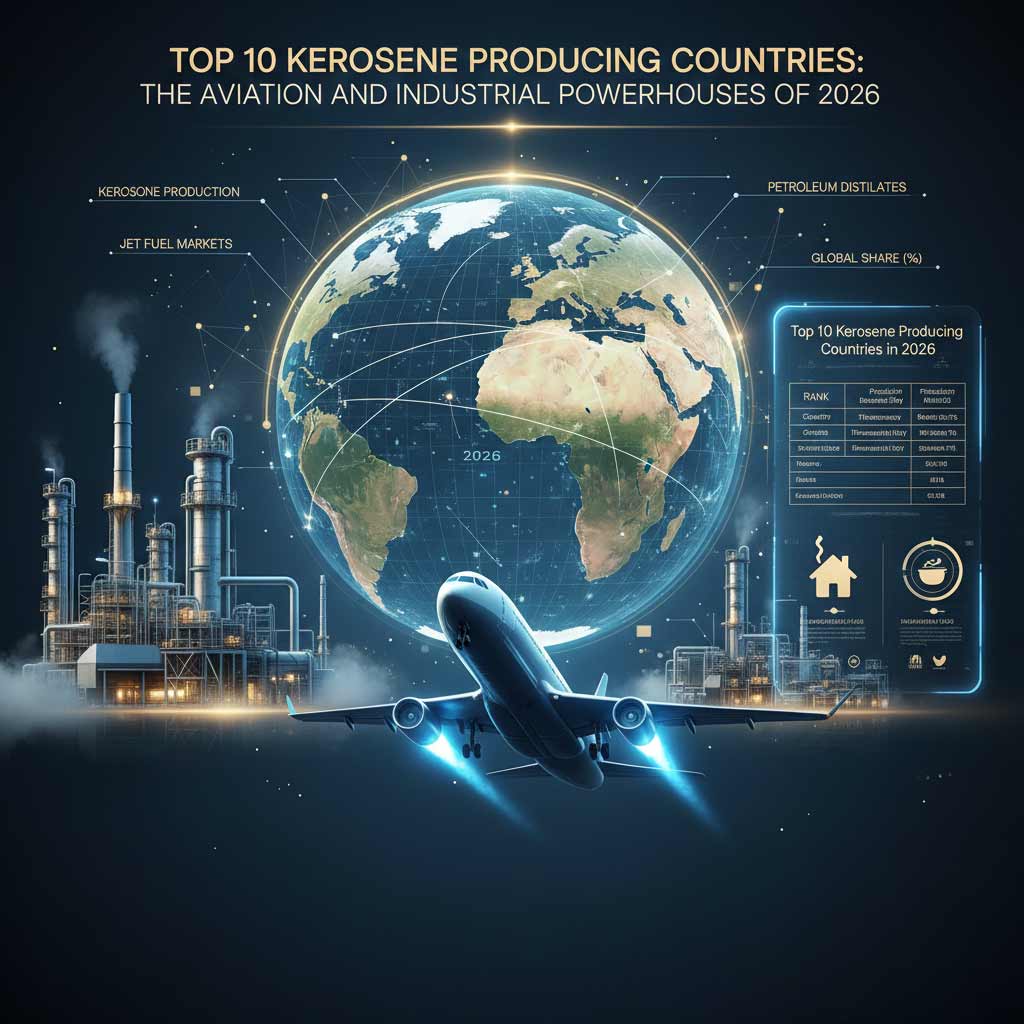
In 2026, the global energy market is experiencing a significant pivot as the aviation sector fully surpasses pre-pandemic milestones, driving an unprecedented surge in demand for Jet A-1 fuel. Kerosene, a critical component of the distillate fuels category, remains indispensable not only for global air travel but also as a vital heating and cooking energy source in emerging economies. As the downstream sector undergoes a technological shift, refineries are recalibrating their refinery throughput to prioritize high-purity kerosene over other middle distillates. This report analyzes the Top 10 Kerosene Producers in 2026, identifying the nations that dominate the production of this essential fuel.
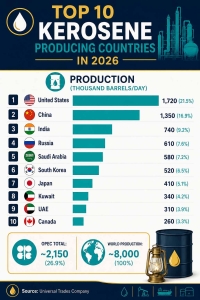
Table: Top 10 Kerosene Producing Countries in 2026
| Rank | Country | Production (Thousand Barrels/Day) | Global Share (%) |
| 1 | United States | 1,720 | 21.5% |
| 2 | China | 1,350 | 16.9% |
| 3 | India | 740 | 9.2% |
| 4 | Russia | 610 | 7.6% |
| 5 | Saudi Arabia | 580 | 7.2% |
| 6 | South Korea | 520 | 6.5% |
| 7 | Japan | 410 | 5.1% |
| 8 | Kuwait | 340 | 4.2% |
| 9 | UAE | 310 | 3.9% |
| 10 | Canada | 260 | 3.3% |
| – | OPEC Total | ~2,150 | 26.9% |
| Total | World Production | ~8,000 | 100% |
1. United States
The U.S. continues to lead the jet fuel markets, supported by its massive domestic aviation industry and sophisticated refinery infrastructure along the Gulf Coast. American refiners, such as Valero and Marathon, have optimized their hydrocracking units to maximize kerosene yields from light-sweet shale oil. While exports to Latin America remain strong, the primary focus in 2026 is meeting the record-breaking demand from North American commercial and cargo airlines.
2. China
China’s kerosene production has reached new heights in 2026 with the full integration of the Yulong mega-refinery. State giants like Sinopec have pivoted their refinery throughput toward middle distillates to support a booming domestic travel market and expanding logistics networks. China also acts as a strategic exporter to the broader Asia-Pacific region, balancing its domestic industrial needs with high-value kerosene exports to neighboring trade partners.
3. India
Positioned as a premier global refining hub, India has significantly expanded its kerosene output. The Jamnagar refinery complex, operated by Reliance Industries, remains a global leader in producing high-spec Jet A-1. In 2026, India serves as a critical supplier of petroleum distillates to Europe and Southeast Asia, leveraging its strategic geographic location and low processing costs to dominate the export-oriented kerosene market.
4. Russia
Russia maintains a dominant position in kerosene production, primarily through the modernization of its specialized refineries in the Volga-Urals and Siberian regions. Despite shifting global trade routes, Russian kerosene remains a staple in the jet fuel markets of Central Asia and parts of Africa. Russian output is also essential for domestic aerospace requirements and rural heating needs, where kerosene remains a preferred fuel for its high energy density.
5. Saudi Arabia
Under the expansion of its downstream strategy, Saudi Aramco has transformed the Kingdom into a kerosene superpower. New refinery capacities in Jazan and Yanbu are specifically designed to process heavy crude into high-value kerosene and jet fuel. In 2026, Saudi Arabia leverages its massive production to supply the growing aviation hubs in the Middle East, while also securing long-term export contracts with European aviation conglomerates.
6. South Korea
South Korea operates a highly efficient refinery model that excels in “toll-refining” for the global market. With no domestic crude, Korean refiners utilize world-class infrastructure to produce premium kerosene for export. In 2026, South Korean kerosene is the primary fuel source for many major airports across the Asia-Pacific, maintaining its reputation for consistent quality and high-throughput reliability in the petroleum distillates sector.
7. Japan
Japan’s refining industry remains a major player despite an overall decline in domestic fuel consumption. Japanese refiners have specialized in high-purity kerosene used for both aviation and residential heating. In 2026, Japan continues to balance its production to meet seasonal heating demands while exporting surplus jet fuel to international carriers operating out of Narita and Haneda, ensuring its refineries stay competitive in a shifting market.
8. Kuwait
Kuwait has seen a surge in kerosene production following the successful ramp-up of the Al-Zour refinery. This facility is one of the largest in the world and is optimized to produce ultra-low sulfur distillates. Kuwait National Petroleum Company (KNPC) has positioned the country as a vital supplier of environmentally compliant jet fuel, targeting European and Asian markets that demand the highest standards for kerosene production.
9. UAE
The United Arab Emirates, led by ADNOC, has integrated kerosene production into its broader chemical and energy hubs. The Ruwais refinery expansion has allowed the UAE to increase its share of the global jet fuel market. In 2026, the UAE is not just a consumer of jet fuel for its massive airlines like Emirates and Etihad, but a leading regional exporter, supplying the growing demand across the African continent.
10. Canada
Canada’s kerosene output is anchored by its refineries in New Brunswick and Alberta. While much of the global focus is on Canadian crude exports, its domestic production of petroleum distillates is crucial for the North American market. In 2026, Canadian kerosene is essential for arctic logistics, northern heating, and as a steady contributor to the integrated North American aviation fuel supply chain.
Read more in our industrial collection
To gain a comprehensive understanding of the energy market in 2026 and deeper insight into developments in strategic commodities, follow our specialized reports:
Key Rankings:
- Top oil-producing countries
- Countries with the largest oil reserves
- Largest crude oil-consuming countries
- Largest gasoline-producing countries
- Largest diesel-producing countries
- Top oil refineries in the world
- Leading countries in petroleum products production
Kerosene Analyses:
Industrial Products and Derivatives:
Global Petroleum Trade Solutions | Universal Trades
As a reputable international petroleum trading enterprise, Universal Trades specializes in the reliable procurement, export, and supply chain management of high-grade petroleum commodities, refined fuels, and industrial feedstocks designed to meet rigorous global standards.







Your place is valueble for me. Thanks!…