
Petroleum Coke (Petcoke) vs. Coal: Which Fuel Reigns Supreme for Industry?
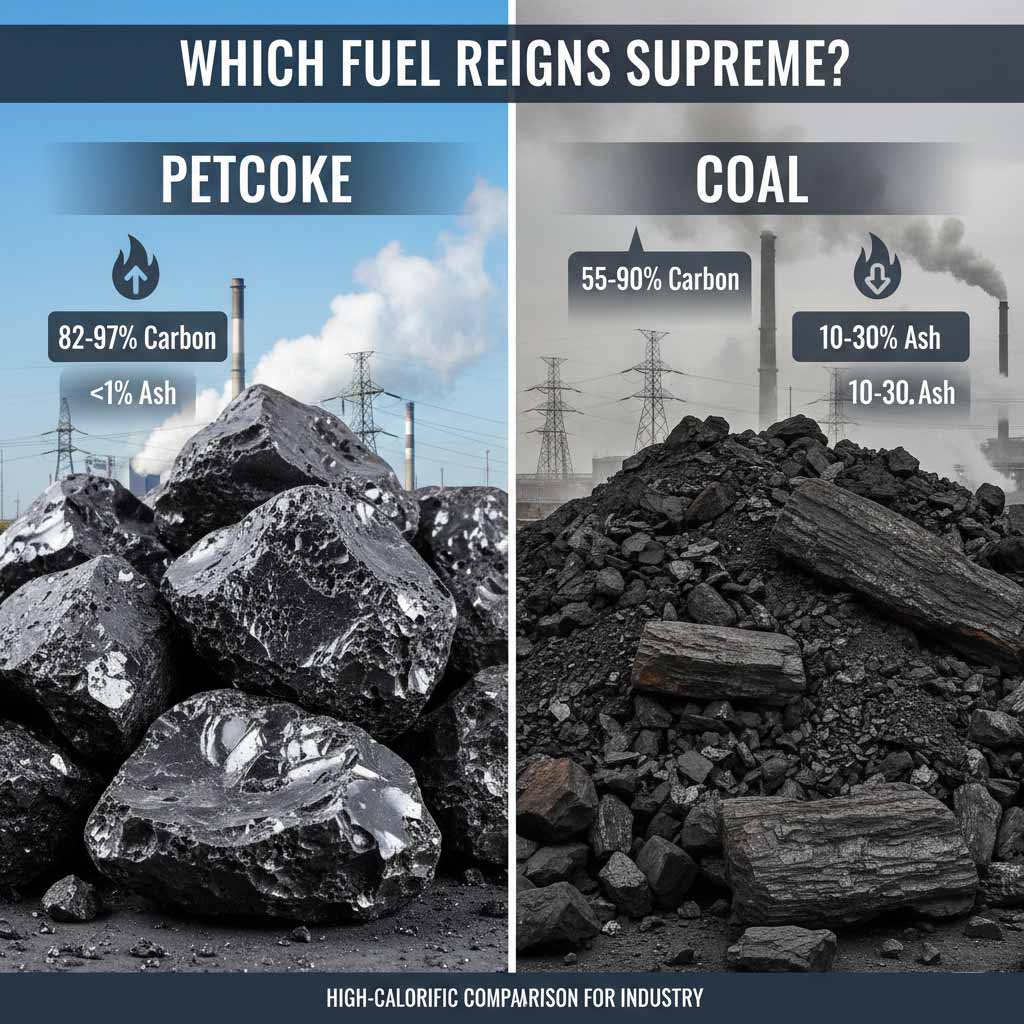
Petroleum Coke (Petcoke) vs. Coal: A high-calorific comparison. Discover the essential differences in energy content, ash residue, and environmental impact between Petroleum Coke—a carbon-rich byproduct of refining Petroleum products—and traditional coal. Petcoke boasts an exceptional fixed carbon percentage (82-97%) and extremely low ash content (typically <1\%), making it a powerful, though often high-sulfur, industrial fuel alternative to coal (55-90% carbon, 10-30% ash).
Petroleum Coke vs. Coal: A Detailed Comparison for Industrial Use
When selecting a solid fuel for industrial applications like power generation, cement production, or steel manufacturing, the choice often narrows down to two main contenders: coal and Petroleum Coke (Petcoke). As a primary byproduct of refining heavy Petroleum products like Gasoline, Bitumen, and Kerosene, petcoke presents a high-energy alternative to the widely used coal. Understanding the core differences between these fuels is crucial for optimizing efficiency, cost, and environmental compliance.
What is Petroleum Coke?
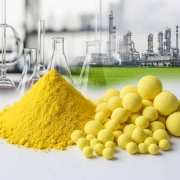
Petroleum Coke is a solid carbonaceous material derived from the final thermal processing (coking) of the heavy residual oils left over after distillation and cracking of crude oil. It is an essential step in producing lighter fuels. Its composition is dominated by carbon, making it an exceptionally energy-dense fuel.
What is Coal?
Coal is a naturally occurring, readily combustible black or brownish-black sedimentary rock, formed from ancient plant matter. It is a heterogeneous material, varying significantly in quality (e.g., Lignite, Bituminous, Anthracite), and is used globally as a primary source for electricity generation and other industrial processes.
Which is better, Petroleum Coke or Coal?
The “better” fuel is entirely dependent on the specific industrial application, required energy output, and local environmental regulations.
-
Petroleum Coke is generally superior in terms of energy density (higher calorific value) and ash content (much lower residue). This makes it highly efficient for processes requiring intense heat, such as cement kilns and some power boilers. However, petcoke often contains a significantly higher percentage of Sulfur, leading to greater sulfur dioxide (SO2) emissions which require costly abatement technologies.
-
Coal is typically more abundant and cheaper than petcoke. Low-sulfur varieties can be more environmentally friendly in terms of SO2 emissions, and some high-rank coals (like Anthracite) can rival petcoke’s energy content. Its combustion properties are generally better understood and easier to manage in conventional power plants.
Comparison Table: Advantages and Disadvantages
| Feature | Petroleum Coke (Petcoke) | Coal |
| Calorific Value | Higher (Typically 28-35 MJ/kg) | Lower to Moderate (Typically 25-35 MJ/kg for high-rank coal) |
| Fixed Carbon Content | Very High (82-97%) | Moderate to High (55-90%) |
| Ash Content | Very Low (Typically <1\%) | High (10-30%) |
| Sulfur Content | Often High (Can exceed 5-7%) | Low to Moderate (Typically 0.5-3.0%) |
| Source | Byproduct of crude oil refining (Petroleum products) | Mined natural resource |
| Cost | Typically higher than coal (but cost-effective due to efficiency) | Generally lower and more volatile |
| Emissions (per mass) | Higher CO2 (due to high carbon) and higher SO2 | Lower CO2 (per mass) and lower SO2 (for low-sulfur coal) |
| Main Industrial Use | Cement, Anodes (Calcined Coke), Power Generation | Electricity Generation, Steel, Heat |
Does Petroleum Coke burn faster than coal?
In a general sense, yes, petroleum coke typically burns faster than coal, but this depends significantly on the type of coal and the combustion technology used.
Petcoke often has a lower volatile matter content than most coals. Volatile matter is the component that ignites easily to start combustion. However, petcoke’s extremely high fixed carbon content and lower particle density mean that once ignition is achieved, the solid carbon residue (char) burns out more rapidly. This leads to a higher heating rate, which can result in more efficient, complete combustion in specialized high-temperature boilers, or conversely, can lead to issues with unburned carbon in ash when co-fired with coal in conventional boilers. Therefore, specialized technology, such as circulating fluidized bed (CFB) boilers, is often preferred for efficient petcoke combustion.




Given the high carbon percentage of Petcoke, is it more cost-effective than anthracite coal for use in the steel industry?
Yes, Petcoke offers higher efficiency in terms of calorific value and fixed carbon. However, due to its high sulfur content, the steel industry primarily uses needle or calcined coke for electrodes to maintain steel quality.