
emulsion bitumen vs cutback bitumen
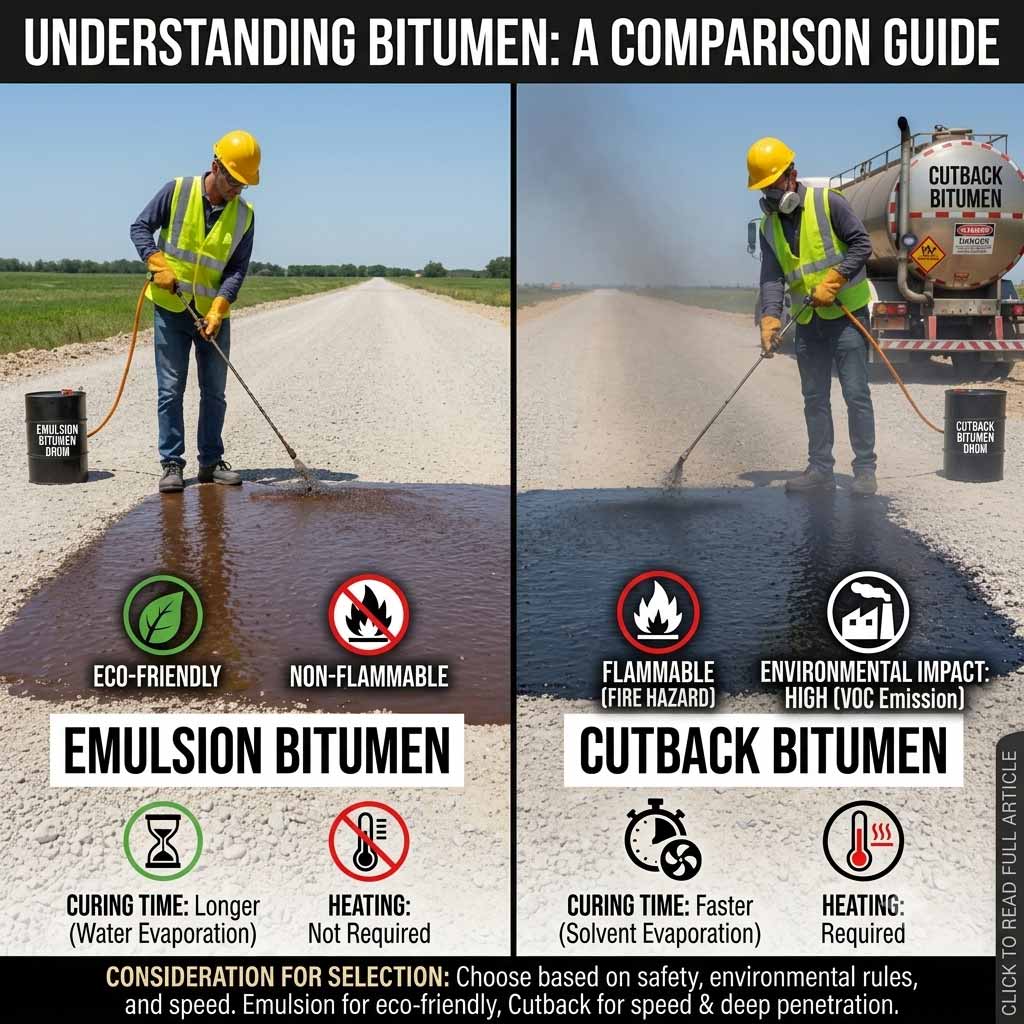
Cutback and emulsified bitumen are two common types used in road construction and civil engineering, each with distinct properties and applications.
Cutback bitumen is produced by dissolving bitumen in petroleum solvents like kerosene or gasoline. It flows easily at ambient temperature and is easy to apply, but its solvent evaporation poses environmental concerns.
Emulsified bitumen, on the other hand, is made by mixing bitumen with water and emulsifying agents. It is more eco-friendly since it contains no organic solvents, and only water evaporates during application.
Bitumen plays a vital role in road construction and waterproofing, offering durability and flexibility in various civil engineering applications. Among its types, cutback and emulsified bitumen are widely used, each with unique characteristics.
Cutback bitumen is produced by dissolving pure bitumen in petroleum solvents like kerosene or gasoline. This reduces its viscosity, making it easier to apply at ambient temperatures. After application, the solvent evaporates, leaving the bitumen to bind with the surface. It is particularly suitable for cold climates and base layer stabilization.
Emulsified bitumen, on the other hand, is created by mixing bitumen with water and emulsifying agents. This forms a two-phase system where bitumen droplets are suspended in water. Upon application, the water evaporates, leaving the bitumen behind. Its eco-friendly nature makes it a preferred choice in projects with environmental considerations.
In terms of safety, emulsified bitumen is superior due to the absence of flammable solvents. It poses fewer risks during transport and storage and is generally more cost-effective. However, its application requires specialized equipment such as emulsion sprayers, and it may be sensitive to weather conditions.
Choosing between the two depends on project requirements, climate, and environmental impact. Cutback bitumen is ideal for deep penetration and cold weather use, while emulsified bitumen is better suited for surface treatments, patching, and cold mix asphalt in warmer regions.
What Are the Four Main Types of Bitumen?
- Straight Run Bitumen
- Cutback Bitumen
- Emulsion Bitumen
- Polymer Modified Bitumen
What Is Emulsion Bitumen and How Is It Produced?
Emulsion bitumen is a mixture of bitumen, water, and emulsifying agents. It is produced using a high-speed colloid mill that disperses bitumen droplets into water. This type of bitumen does not require heating and is considered environmentally friendly.
What Is Cutback Bitumen?
Cutback bitumen is made by blending bitumen with volatile solvents such as kerosene or naphtha. These solvents reduce the viscosity, allowing it to be applied at ambient temperatures. After application, the solvents evaporate, leaving behind the bitumen.
Key Differences Between Emulsion and Cutback Bitumen
| Feature | Emulsion Bitumen | Cutback Bitumen |
|---|---|---|
| Base | Water | Petroleum Solvent |
| Flammability | Non-flammable | Flammable |
| Drying Speed | Slower | Faster |
| Heating Requirement | No | Yes |
| Environmental Impact | Low | High |
| Cost | Lower | Higher |
| Applications | Fog seal, patching | Prime coat, rapid paving |
Types of Emulsion and Cutback Bitumen
- Emulsion Bitumen: CRS (Cationic Rapid Setting), CMS (Medium Setting), CSS (Slow Setting)
- Cutback Bitumen: MC30, MC70, MC250, MC800, MC3000 (based on viscosity)
Which Type Is Harder?
Cutback bitumen becomes harder after solvent evaporation. Emulsion bitumen hardness varies depending on its setting type (CRS is harder than CSS).
Pros and Cons of Each Type
Emulsion Bitumen
- Pros: Safe, no heating, eco-friendly
- Cons: Longer curing time, temperature-sensitive
Cutback Bitumen
- Pros: Quick application, strong adhesion
- Cons: Fire hazard, environmental pollution
Applications of Emulsion and Cutback Bitumen
| Type | Applications |
|---|---|
| Emulsion | Fog sealing, crack sealing, cold mix asphalt |
| Cutback | Prime coat, surface dressing, base layers |
Which Bitumen Is Better?
The choice depends on project needs, environmental concerns, and safety. Emulsion bitumen is ideal for sustainable and safe projects, while cutback bitumen suits fast-paced operations requiring strong bonding.
Global Petroleum Trade Solutions | Universal Trades
As a reputable international petroleum trading enterprise, Universal Trades specializes in the reliable procurement, export, and supply chain management of high-grade petroleum commodities, refined fuels, and industrial feedstocks designed to meet rigorous global standards.







In terms of safety and environmental impact, what advantages does Emulsion Bitumen have over Cutback Bitumen?
Emulsion Bitumen has a decisive advantage in safety and environmental aspects because: 1. No Petroleum Solvents: It contains no volatile organic solvents, resulting in lower air pollution and being environmentally friendly. 2. High Safety: Due to its water base, it is non-flammable, eliminating fire and explosion risks associated with solvent vapors during handling and application. In contrast, Cutback Bitumen, due to its petroleum solvents, is both flammable and releases Volatile Organic Compounds (VOCs) into the atmosphere upon curing.