
Gasoline vs. Diesel: Everything You Need to Know About These Two Fuels

In today’s world, fuel is paramount in the transportation industry and various other sectors. Among the many petroleum products, gasoline (petrol) and diesel stand out as two key players, each with unique characteristics and applications. But have you ever considered the fundamental differences between them? This comprehensive article will delve into the deep distinctions between diesel and gasoline from chemical composition, production processes, engine performance, fuel consumption, and emissions perspectives. Our goal is to provide you with a complete understanding of these two vital fuels. Join us as we compare gasoline and diesel and explore which might be the better choice!
Comparison Table: Gasoline vs. Diesel (Fuels & Engines)
Here is a quick, comprehensive summary of the key physical, chemical, and mechanical differences between gasoline and diesel, as well as their respective engines:
| Comparison Feature | Gasoline (Petrol) | Diesel |
| Combustion Metric | Octane Number: Measures resistance to autoignition/knocking. | Cetane Number: Measures the speed and readiness of autoignition. |
| Chemical Composition | Lighter hydrocarbons with shorter carbon chains (C5 to C12). | Heavier hydrocarbons with longer carbon chains (C12 to C20). |
| Density & Energy | Lower density; contains less energy mass per volume. | Higher density; contains more mass and higher energy efficiency. |
| Boiling Point | Lower range (approx. 30 to 220°C); vaporizes easily. | Higher range (approx. 180 to 380°C). |
| Safety | Lower safety in handling: Highly volatile with a very low flash point (~ -43°C), making it highly flammable at room temperature. | Higher safety in handling: Low volatility with a higher flash point (~ 52°C); inherently safer to store and handle. |
| — | — | — |
| Engine Type | Spark-Ignition (SI) Engine | Compression-Ignition (CI) Engine |
| Ignition Mechanism | Air-fuel mixture is compressed and ignited by a spark plug. | Air is heavily compressed until hot, then fuel is sprayed to autoignite. |
| Fuel Consumption | Higher fuel consumption due to lower thermal efficiency. | Lower fuel consumption (longer driving range per tank). |
| Engine Lifespan | Shorter lifespan: Higher RPMs and lighter components lead to quicker wear and tear over time. | Longer lifespan: Robust, heavy-duty construction built to withstand high compression, often lasting twice as long. |
| Maintenance Costs | Lower regular maintenance costs: Parts are generally cheaper, and the exhaust/emission systems are less complex. | Higher maintenance costs: Components (like injectors and turbochargers) and advanced emission systems (DPF/SCR) are more expensive to repair or replace. |
| Primary Emissions | Carbon Oxides (CO), Unburnt Hydrocarbons (HC), and NOx. | Particulate Matter (PM) and Nitrogen Oxides (NOx). |
| Modern Emission Tech | Three-way catalytic converters. | DPF (Diesel Particulate Filter) and SCR systems (with ULSD). |
| Common Applications | Light passenger cars, motorcycles, and small tools. | Heavy-duty trucks, buses, ships, and industrial machinery. |
Chemical and Physical Differences: From Structure to Properties
While both gasoline and diesel are derived from crude oil, their distinct chemical compositions and physical properties lead to significant differences in how they perform in engines:
Octane Number (Gasoline) vs. Cetane Number (Diesel): Combustion Quality Metrics
- Octane Number (Gasoline): This number indicates gasoline’s resistance to autoignition or premature combustion, commonly known as “engine knocking.” Higher octane gasoline ignites later and tolerates greater compression, which is crucial for high-compression gasoline engines requiring precise ignition timing.
- Cetane Number (Diesel): Unlike octane, the cetane number measures diesel’s tendency to autoignite and its flammability. A higher cetane number means the diesel ignites more quickly and readily. This property is vital for diesel engines, where fuel combustion relies on compression and the resulting heat, significantly impacting cold starts and smooth engine operation.
Density: Impact on Fuel Consumption
Diesel generally has a higher density than gasoline. This means that for the same volume (e.g., one liter), diesel contains more mass and thus more energy. This density difference is a primary reason for the higher energy efficiency and typically lower fuel consumption observed in diesel vehicles compared to gasoline ones.
Boiling and Flash Points: Safety and Performance
- Boiling Point: Gasoline has a lower boiling point range (approximately 30 to 220°C) compared to diesel (around 180 to 380°C). This difference allows gasoline to vaporize more easily at lower temperatures, a necessary characteristic for combustion in gasoline engines.
- Flash Point: The flash point is the minimum temperature at which a liquid produces enough vapor to form a flammable mixture with air. Gasoline has a very low flash point (around -43°C), making it highly volatile and flammable. In contrast, diesel has a higher flash point (around 52°C), which makes it inherently safer to handle than gasoline, but also means it requires specific conditions (like high pressure and heat in diesel engines) for ignition.
Viscosity: Lubrication and Fuel Injection
Diesel exhibits higher viscosity (or thickness) than gasoline. This property influences both fuel injection and lubrication within diesel engines. The appropriate viscosity of diesel helps lubricate the fuel pump and injector components. However, excessively high viscosity can lead to improper fuel atomization and incomplete combustion.
Hydrocarbon Composition: Distinct Carbon Chains
Gasoline is primarily composed of lighter hydrocarbons with shorter carbon chains (typically C5 to C12). These shorter chains contribute to gasoline’s higher volatility and flammability. Conversely, diesel consists of heavier hydrocarbons with longer carbon chains (typically C12 to C20), which account for its higher density, elevated boiling point, and ability to combust under high pressure.

Sulfur Content and Other Additives: The Importance of Environmental Standards
Historically, diesel contained higher levels of sulfur, which produced sulfur oxides (SOx) upon combustion, contributing to air pollution and acid rain. With technological advancements and stringent environmental regulations, the sulfur content in diesel has been drastically reduced (leading to Ultra-Low Sulfur Diesel or ULSD) to minimize these emissions. Both gasoline and diesel contain various additives designed to enhance performance, protect engine components, reduce deposits, and prevent corrosion.
Differences in Production Process: Crude Oil Refining
Both petroleum products are derived from crude oil and refined in distillation columns, but they are obtained from different “fractions” or cuts:
- Gasoline: Primarily derived from lighter crude oil fractions during the distillation process. To improve its quality and octane number, processes such as “cracking” (breaking long carbon chains), “reforming” (rearranging molecules), and the addition of oxygenates are employed.
- Diesel: Obtained from heavier crude oil fractions (after the gasoline and kerosene cuts) in the distillation column. For quality diesel production, processes like “hydrotreating” (sulfur reduction) and cetane number enhancement are also carried out.
Differences in Engine Types Used: Spark vs. Compression
The distinct chemical and physical properties of gasoline and diesel necessitate fundamentally different engine designs:
Gasoline Engines (Spark Ignition)
In gasoline engines (known as spark-ignition or SI internal combustion engines), gasoline vapor is mixed with air. This mixture is then compressed in the cylinder and ignited by a spark plug. This rapid and controlled combustion process is well-suited for engines that require high RPMs and quick responsiveness.
Diesel Engines (Compression Ignition)
In diesel engines (known as compression-ignition or CI engines), only air is heavily compressed in the cylinder, causing its temperature to rise significantly. When diesel is sprayed as a fine mist into this hot, compressed air, it immediately autoignites without the need for a spark. Consequently, diesel engines do not require spark plugs and achieve higher efficiency due to their much higher compression ratios.
Differences in Fuel Consumption and Emissions: Efficiency and Environmental Footprint
Fuel Consumption
Due to the higher thermal efficiency of diesel engines and the greater energy density of diesel fuel, diesel vehicles generally have lower fuel consumption (measured in liters per kilometer or miles per gallon) compared to gasoline vehicles of similar power. This translates to longer driving ranges on a single tank of fuel.
Types of Pollutants
Both engine types produce pollutants, but the types and quantities differ:
- Gasoline Engines: Primarily produce carbon oxides (CO), unburnt hydrocarbons (HC), and nitrogen oxides (NOx). The use of three-way catalytic converters has significantly reduced these emissions.
- Diesel Engines: Historically, their primary emissions included particulate matter (PM) and nitrogen oxides (NOx). However, with the introduction of Ultra-Low Sulfur Diesel (ULSD) and the implementation of Diesel Particulate Filters (DPF) and Selective Catalytic Reduction (SCR) systems to control NOx, emissions from modern diesel engines have been drastically reduced, often making them as clean or even cleaner than some gasoline engines.
Pros and Cons: Which Fuel is More Suitable?
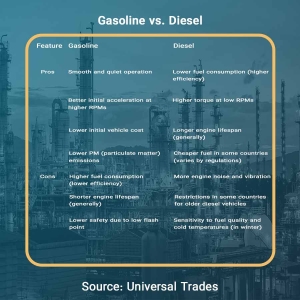
Common Applications: What Is Each Fuel Used For?
- Gasoline: Primarily used in light passenger vehicles, motorcycles, small boats, and small gardening and industrial tools. It’s ideal for applications requiring rapid acceleration and dynamic performance.
- Diesel: The main choice for heavy-duty vehicles such as trucks, buses, trains, ships, agricultural and construction machinery, and industrial power generators. The high power and torque of diesel engines make them ideal for carrying heavy loads and demanding industrial applications.
Specialized Articles on Gasoline and Diesel
What Is Reformulated Gasoline? | An introduction to reformulated gasoline (RFG), including its key characteristics, advantages, and potential drawbacks.
Signs and Problems of Low‑Quality Gasoline | A detailed look at the common indicators of poor‑quality gasoline and methods used to identify fuel quality issues.
Top 10 Gasoline‑Producing Countries | A review of the leading countries involved in gasoline production and their role in the global fuel market.
Gasoline Color Explained | What gasoline color indicates and why different types of gasoline may appear in different colors.
Gasoline vs. Kerosene | Key differences between gasoline and kerosene, along with situations where each fuel is more suitable.
Naphtha vs. Gasoline | An explanation of the similarities and differences between naphtha and gasoline and how they are used in industry.
E85 Gasoline | An introduction to E85 fuel, a gasoline blend known for its lower emissions and alternative fuel characteristics.
Euro 3 vs. Euro 4 Diesel | A detailed comparison of Euro 3 and Euro 4 diesel standards, covering their main characteristics, advantages, limitations, and typical applications.
Euro 4 vs. Euro 5 Diesel | An overview of the differences between Euro 4 and Euro 5 diesel, including emission standards, fuel quality, and performance considerations.
Euro 5 vs. Euro 6 Diesel | A comprehensive comparison of Euro 5 and Euro 6 diesel standards, focusing on emission limits, environmental impact, and practical usage.
Signs of Poor‑Quality Diesel | How to identify low‑quality diesel through visual indicators and laboratory testing methods.
Conclusion
The differences between diesel and gasoline extend far beyond their color and odor. These two petroleum products, with their distinct chemical compositions, physical properties, and combustion mechanisms, are optimized for specific types of engines and applications. Understanding these distinctions will not only help you make a more informed choice for your vehicle but also provide a deeper insight into the complexities of the fuel industry and its crucial role in our daily lives. With ongoing technological advancements, both fuels and their corresponding engines are continuously improving to offer greater efficiency and reduced emissions.
Do you have any more questions about the comparison between gasoline and diesel, or perhaps want to know more about the differences between gasoline and diesel engines? Feel free to share your comments and questions with us!






Why do diesel engines typically have lower fuel consumption than gasoline engines, and what pollutants do they produce?
Thank you for bringing up this important point! Diesel engines generally have lower fuel consumption (liters per kilometer) than gasoline engines of similar power due to their higher thermal efficiency and greater energy density of diesel (meaning diesel has more energy per unit volume). This translates to longer travel distances on a single tank.
Regarding emissions, diesel engines historically produced primarily particulate matter (PM) and nitrogen oxides (NOx). However, with technological advancements and the introduction of ultra-low sulfur diesel (ULSD), along with systems like diesel particulate filters (DPF) and selective catalytic reduction (SCR) systems, emissions from new diesel engines have been significantly reduced, in some cases even becoming cleaner than gasoline engines.
The article explains that Octane resists auto-ignition, and Cetane encourages it. If I accidentally put Diesel into a Gasoline engine, what actually fails first? Is it just knocking, or is it a complete mechanical failure?
It’s usually a catastrophic failure, not just simple knocking. The extremely low Octane (high Cetane) of Diesel will cause the fuel to auto-ignite almost immediately upon compression (before the spark plug fires), leading to severe, uncontrolled detonation and potential piston/rod damage almost instantly. Plus, Diesel’s low volatility means it won’t properly vaporize for combustion.
Why aren’t spark plugs used in diesel engines, and does this make the car harder to start in winter?
In a diesel engine, air is compressed so much that it becomes hot enough to cause the diesel fuel to ignite spontaneously. This is why spark plugs are removed. Yes, in cold weather, because it is harder to heat the air through compression, diesel engines need internal glow plugs to make the initial start easier.
Perfect just what I was looking for! .